

As a Marriage and Family therapist, we believe in 5 major life cycles that we as humans, experience from birth to end of life. One of the most rewarding and stressful is parenting. Our goal as parents is to launch healthy, productive citizens into this world! The college or trade school transition is one of the most monumental phase of life for both the parents and the child! An issue I discuss in office with families is, what happens when the child leaves for college and comes back into the “home” as perceived young adult?
This holiday return of a college-aged child is an opportunity and a stress test. As therapists, we see the same themes: role confusion, resurrected family patterns, unspoken expectations around money and chores, and the tricky shift from parent–child to adult–adult interaction. When framed and navigated well, holiday homecomings can strengthen family attachment and autonomy. When handled poorly, they reinforce dependence, resentment, and stalled development. This guide gives therapists clear ways to prepare parents and families — practical tools, in-session interventions, and short scripts that support healthier boundary-setting and mutual respect.
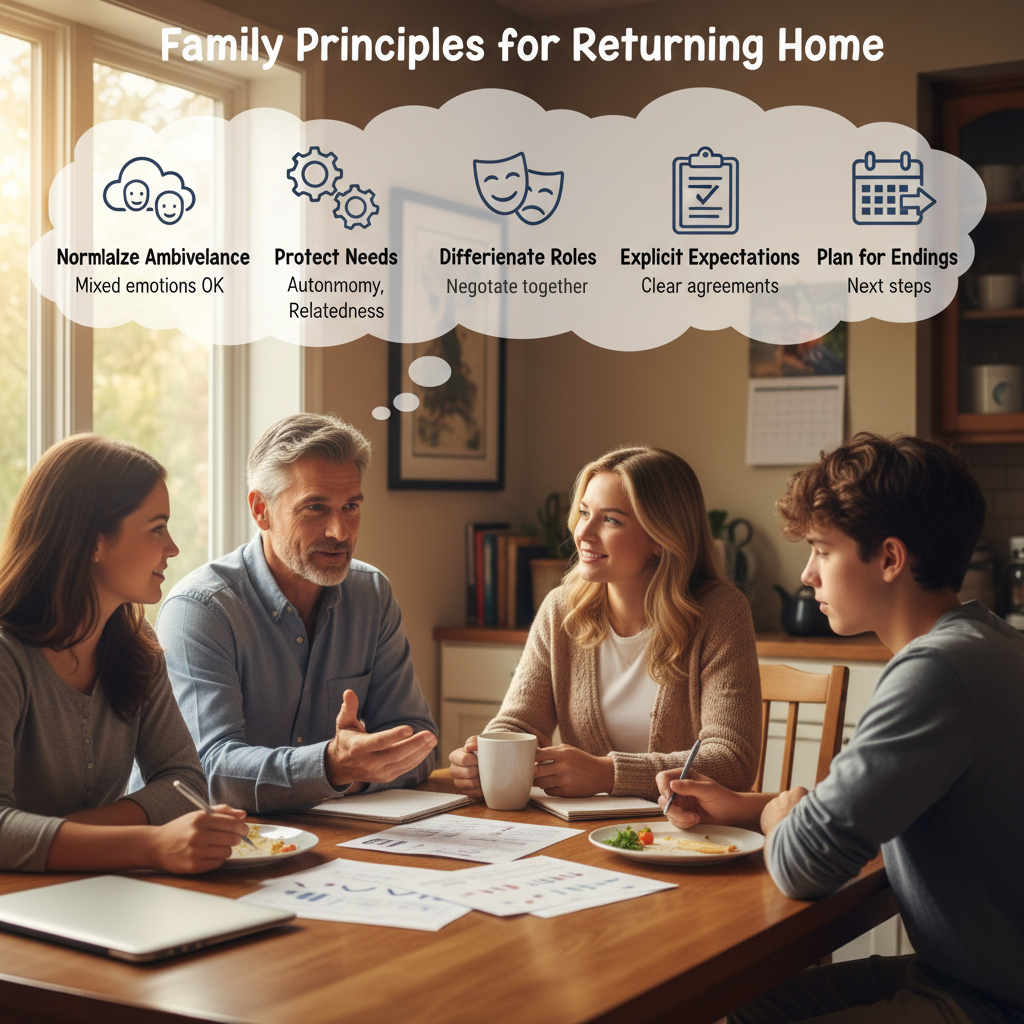
Core principles/behaviors that families can implement
- Normalize ambivalence. Returning home triggers mixed emotions for everyone. Normalizing reduces shame and defensiveness and opens the door to negotiation rather than blame.
- Protect basic developmental needs. Use Self-Determination Theory as a touchstone: parents should support autonomy, competence, and relatedness — not rescue or control.
- Differentiate roles. A returning student may act like an adult in many contexts; the household’s rules should be negotiated collaboratively rather than unilaterally imposed.
- Make expectations explicit. Vague expectations create resentment. The solution is brief, specific agreements for the visit. Discuss, “we know you have had freedoms at college, and now back at home, we need to set some boundaries on what the living arrangements are” Parents still have to go to work in the mornings, get up early, etc. even if the child is on “school vacation”
- Plan for endings. Returning home shouldn’t remove the requirement to plan forward — short visits need exit strategies and concrete next steps.
Practical In Home tools you can use with your returning college student:
1) The 20-Minute Holiday Compact
Ask the family to spend 20 minutes writing 5 simple agreements before the visit. Suggested items:
- Sleeping/guest arrangements (who sleeps where; guest policy)
- Shared expenses (groceries, utilities, gas)
- Chore contributions (dishes, trash, laundry)
- Boundaries around privacy and time (work/school hours, quiet times)
- Communication rules (no-phone meals, pause-and-return rule for fights)
Have them sign the compact; clinicians can role-play negotiation.
2) Roles & Responsibility Map (10 minutes)
Using a whiteboard or genogram, map who currently does what in the household. Identify tasks that could reasonably shift to the returning student and tasks that remain parental responsibility. This externalizes the work and prevents globalizing (“you never help”) complaints.
3) One-Line Scripts for Diffusing Conflict
Give parents/children/students three short scripts to try when a fight begins:
- Parent to student (autonomy support): “I hear you — let’s pause and pick this up after dinner.”
- Parent to student (boundary): “I don’t want to argue about this right now. I need you to [do X] while we discuss later.”
- Student to parent (adult stance): “I appreciate this home; I’ll help with groceries and dishes on these days.”
4) The Pause-and-Return Technique
Introduce to each member of the family a 10-minute pause rule: either party can call a pause, during which both do independent breathing/grounding. They return at the agreed time to attempt a 5-minute check-in. This prevents escalation and models mature conflict management.

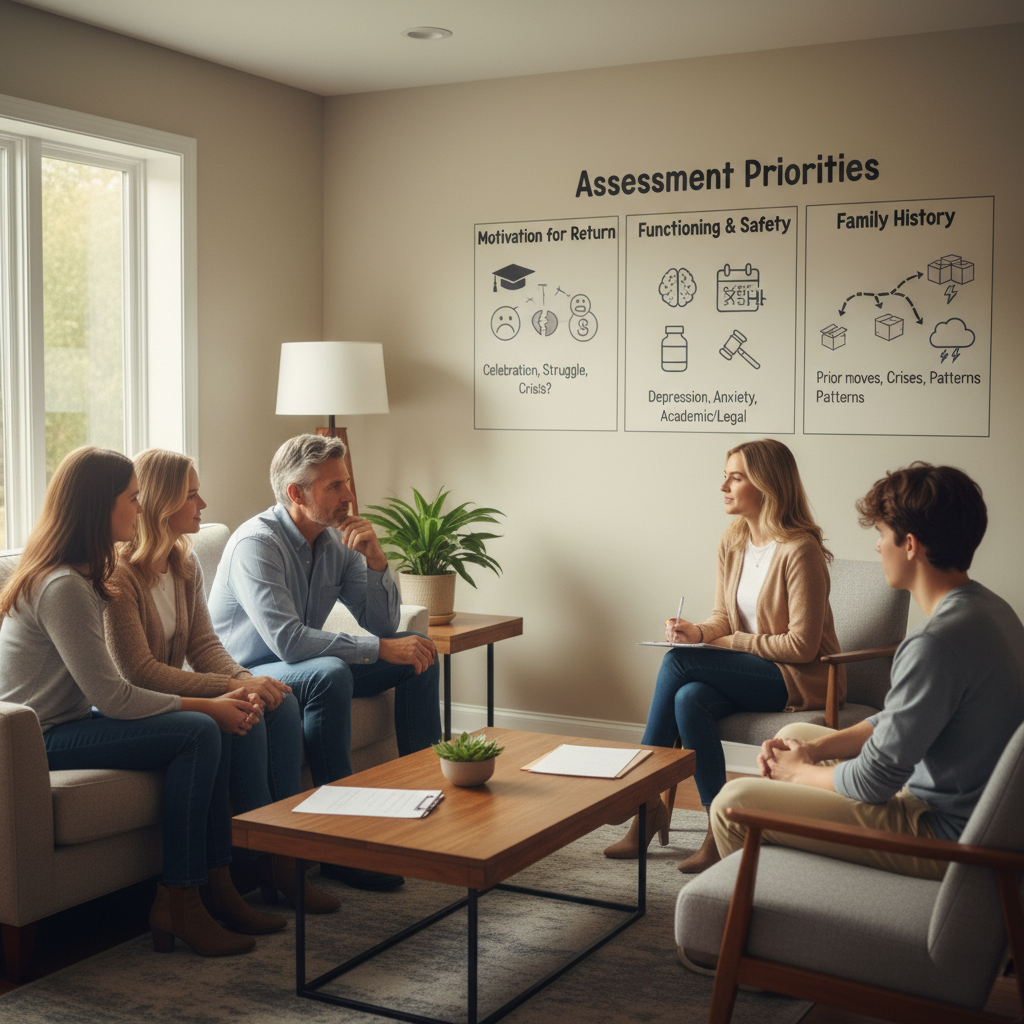
Assessment priorities as preparation for the pre-holiday re-engagement
- Motivation for return. Is the student returning for celebration, or following academic dismissal, mental-health struggle, or financial crisis? The level of concern dictates treatment priorities.
- Functioning and safety. Screen for depression, anxiety, substance use, suicidal ideation, and academic or legal problems. If safety concerns exist, create an urgent plan.
- Family history of transition responses. Use a brief timeline: prior moves, earlier returns, or family crises. Patterns repeat — map them early.
Interventions to use in a therapeutic sesison
- Motivational questioning of student. If the returning student has stalled progress, use MI to elicit their goals (employment, degree completion, housing) and build discrepancy between current behavior and values.
- Parent coaching (brief sessions). Help parents to shift from “doer” to “consultant.” Practical techniques: ask-open questions, step-back reinforcements, and contingent support (helping only when the student meets agreed responsibilities).
- Problem-solving therapy for practical planning. Create a 6–8 step plan for housing, finances, or academic remediation — concrete next steps, deadlines, and accountability checks.
- Emotion coaching for reunion moments. Teach families to label emotions (“I’m frustrated because…”) and pair this with requests for behavior change rather than accusatory statements.

Scripts and communication templates you can practice
- “We’re excited you’re home. Let’s agree on chores and expenses so everyone knows what’s expected.”
- “I want you to feel independent here. Can we try a week where you handle X and I’ll handle Y?”
- “If either of us needs space, let’s use a 10-minute pause and come back to talk at [time].”
The holiday homecoming is an opportunity to reunite with your college age child and set some clear agreements, brief behavioral contracts, and coaching in communication with the college age student, transitioning back into family home. Families can convert a potentially tense reunion into a scaffolding moment for the young adult’s growth and the family’s renewed balance. Prepare and enjoy this next phase of your families growth and life.
